Sunday, December 1, 2019

Commenting Reports

Commenting Reports

Responding to my colleagues blogs is an important tool for blogging. A blog is an outlet for us to relay information in a fun and creative post, allowing the blogger to reflect or inform their thoughts.  The purpose is for the reader to be informed on the topic and that is best expressed through responses, telling the blogger how they felt from reading the blog and was the information creative, useful, and relevant.  I have responded to a few of my classmates blogs.  I hope that I was reflective and insightful to their thoughts.  There are some great discussions (or discourse as I have learned!) that have been written. 


 Great Job everyone!!!


Jason's blog-Grading, Should we use it?
I agree, I tend to go back and forth about the philosophy on grading. But I think I lie on the side of grade as it provides feedback, monitoring data, and allows students to know how they are doing, and where they can improve on. I unfortunately feel that most students will only do as little as possible to receive the grade they want. If they have no bar to work for, will they continue to keep working? I have struggled with this class, not having any grades to reflect my efforts. I find this stressfull, as I'm sure my students would too, not to mention their parents! My daughter's 8th grade teacher attempted a no grade approach for a quarter. My daughter said he found it stressful and stopped doing it after the first quarter was up. Maybe no support from school, or just didn't work i his classroom, but he must have been interested in trying.


Tara L's Blog-Trade Book Project
I agree, the book trailer was a fun and creative project that I bet kids would love to do!! I enjoyed making mine, and after seeing my colleagues' projects, I have so many more ideas on how to make better ones. You connected your lesson topic perfectly with the story of the book. Your blog was well written as well, with lots of insight into your creativity. Well done.

Lauren's Blog-Chapter 7-9 Reflection
This is a comment to your science joke... I have one for you! Two hydrogen atoms walk into a bar. One says, "I think I've lost an electron." The other says, "Are you sure?" The first replies, "Yes, I'm positive." or how about... A neutron walks into a toy store and grabs a toy. The salesman says to the neutron, "For you no charge." Finding fun and creative ways for students to make connections to the content they are learning is a great resource for retaining information. Meeting the needs of all our students will be challenging, but we just need to focus on inventive ways for them to understand subject matter. Poems, rhyme, song, jokes are great tools.

Monday, November 25, 2019

Book Trailer

TradeBooks

Severe Weather/Drought
Kendra Soule

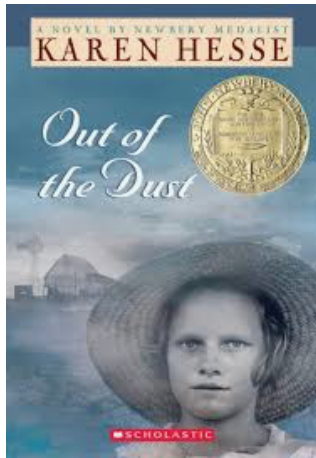
Out of the Dust

Karen Hesse, 1997, Scholastic Press, ISBN 0-590-36080-9

Synopsis of the Book 

Out of the Dust is a John Newbery Medal winner.  It is a lyrical free verse novel that tells the story of Billie Jo, a young girl who lives in the harsh reality of the Oklahoma panhandle during the 1930s Dust Bowl.  Despite the constant dust storms and the struggle to help her family survive, Billie Jo is happy with her life. But a tragic accident changes things forever. As she tries to escape her painful memories and injuries, Billie Jo flees on a freight train, leaving the dust behind.  But Billie Jo has not realized the dust is a part of her, and she must learn to forgive her father and most of all herself. Set against the backdrop of the Dust Bowl and the hardships faced by prairie living, the novel is a testament to the power of hope and the triumph of the human spirit. 

Science Connections

This book tells the story of life during the Great Depression.  Oklahoma experienced severe drought, dust storms, tornadoes, in addition to soil erosion from over farming.  This left the habitants with poor soil, no water and drought like conditions. This story can provide real life experience for living through this and be compared with how life was like, how it used to be, and how life is now in present day.  Lessons can be adapted to show how people accepted this life and/or what they did to adapt and prepare. During Drought conditions habitants often have to leave their homes, go without food or water, these are all side effects of the dust bowl and drought today.     .

Teaching Connections

This book can be used as a vocabulary lesson, as a ‘real’ experience for students to be able to write about or as a book group project on the tragedy of the Dust Bowl and how people survived it.  Out of the Dust tells the story of the sequence of events that led to the erosion of the soil, affecting the water cycle and creating dust storms and ecological disaster.  Review with students that when the grassland was plowed up for farming, the soil became more exposed and vulnerable to erosion and could not hold water as well.  For an introduction to understanding the dust bowl, read other poems or stories. have groups work together, using facts from the book and additional resources to create a diagram that shows the chain of events that led to the dust storms, and measures that helped the storms end.  Have students present their findings and discuss what lessons we can learn from the Dust Bowl.  

Resources

Come on, Rain! by Karen Hesse 
The Year of the Dust by Albert Marrin
Bringing the Rain to Kapiti Plain by Verna Aadema
21 century Challenge!


.


Sunday, November 17, 2019

Physical Science Chapter 16-18


Image result for physical science icon

Physical Science
Matter and MotionChapter 16

This is were science lost me.  Physical science has so many concepts, terminology that still boggles my mind.  Teaching these concepts have always been a direct (learn and memorize) instruction base.  More inquiry-base instruction and cooperative learning to help engage and encourage students to learn.  

Matter
 kinetic molecular theory* chemical change*chemical changes*elements, compounds and mixtures*parts of an atom*nuclear energy

Motion
newton's law*gravity & motion*jet & rocket engines*flight*

Energies and Machines
Chapter 17

How Energy is Transferred
Conservation of energy*Energy Transfer

Electrical Energy
static electricity*current electricity*

Sound Energy
Light Energy
Heat Energy
Machines
Fiction

Physical Science Lesson Ideas
Chapter 18

Like I've said, science lessons were always so boring and overwhelming.  This chapter does provide many examples os inquiry-base instruction where students can apply there understandings and experience to new content.  Hands on experiences are a critical element for student learning.  WebQuest, experiments, projects, and discovery centers are great examples.  


Wednesday, November 13, 2019

Earth Science: Chapter 10-12

Earth & Space Sciences

chapter 10
Earth's Surface, Atmosphere, & Weather
There are so many wonderful lessons to be taught about earth.  
Topics:
Earth Surface, rocks, minerals, fossils, Rock cycle, land mass, 
Oceans, continental shelf
Model of the center of the earth.  styrofoam & paper mache

volcano with diagram of the inside of a volcano for labeling vocabulary 
Earth's atmosphere & weather-water in the atmosphere, violent weather, weather prediction, meteorologist, climage change and global warming

This is one of my favorite topics! I look forward to teaching students about the wonders of our world, and how it has changed from the beginning to continually changing.  

chapter 11  
The Cosmos

What is the Universe, ad how was it formed?
This subject has changed so dramatically since I was a child.  There are more then 9 planets, and one of those planets is not even considered a planet anymore!! 

 topic subjects: big Bang Theory, Magnetars, Quasars, pulsars, & black holes, galaxies, constellations, the sun, the solar systems, the moon, planets, meteors, comets, asteroids.
Image result for solar systems projectsImage result for solar systems projects

Exploring the first steps of space; the space launch, there is a field trip that local schools take that have an exhibit about the launch.  There is a lot that can be done with this topic.  

Chapter 12
lesson Ideas
This chapter reflects on probes-determining what the students already know
probes-basic questions and simple activities that get children thinking and talking about particular topics.  Probes are great ways to get children talking engaging prior knowledge.  It's also a great way for teachers to assess what they my know.     
Starter Ideas for weather:  Weather Predictions,
Question: How do we know a storm is coming?
Unit overview: students identify the forms of technology used by meteorologists and build a model of at least one instrument used to gather weather observations. 


Read it! Chapter 7 Engineering

Integrating Science and Engineering

Science & ELA
  • Science, Engineering and ELA can be integrated together as they cut across disciplines and are useful in understanding concepts.  
  • Trade Books or textual resources are important to engage students and motivate them to think in inquiry-based research.  Trade books are not fictional stories on a topic or even text books, they focus on scientific adventures, the lives of scientists and science careers and provide factual material about stars,  planets, dolphins, etc.  
  • Crossing subject matter barriers using language arts as the bridge is creative and effective. 

  1. Literature-Based integration
  2. Theme-based integration
  3. Project-based integration
Image result for flashing arrowLanguage arts teaching strategies can be easily adapted to enrich and extend children's science experiences.  Writing stories along with a science topic.  My daughters had to create a story that went along with the concepts of gas, liquid, and solids.  One story was of an ice-cube who melted and froze and evaporated.  The second daughter wrote about a busy bee fly everywhere (that symbolized gas), then as the bees met each other and were moving less (liquid) then bees made a hive that was small so they could barely move (solid).  These stories helped them to understand the concept better and put it in different context.  It also helped them to use specific vocabulary associated with the subject matter.  

Science/Engineering & Math
  • Computational Skills
  • Data Collection and Expression
  • Logical reasoning skills
  • As students become more proficient in seeking explanations based on evidence, math will give students the tools to see patterns and express relationships.  
Science/Engineering & Social Studies
  • Social issues provide contexts that often make the need for explanations or solutions to problems purposeful.  
  • ex. designing user-friendly recycling bins demands an awareness of social issues, scientific principles, and engineering design for integration. 

Wednesday, November 6, 2019

Read it! Chapters 5 & 6

Chapter 5
Creating Science workspace

  • discovery stations
  • adding some life to the classroom eg. aquarium, plants
  • consider other senses e.g sound of ocean, jungle, woodlands
  • distributing materials 
  • providing work areas
  • providing clear directions
  • create routines
Encourage science talk
  • questioning strategies
    • convergent-get children to think in ways that focus on basic knowledge
    • divergent-think about a # of alternative answers
    • evaluative-gets students to offer a judgement based on some critera
  • wait-time/think time strategies
    • give time 
    • partner share
  • Fostering active listening strategies
  • science talk and the science circle
    • recap, redirect, re-voice, restate
Encourage Collaboration
  • teach social and small group skills
Chapter 6
Assessment of Understanding and Inquiry
Formative Assessments
Summative Assessments


Assessment Strategies
  • Prompt and Rubric
  • performance assessments
  • portfolios
  • Science journals
  • Affective Development Checklists
  • Science Conferences with Children
  • Science probes
  • Concept mapping
  • Self Assessments
  • End of chapter assignment
  • quizzes
  • unit tests
  • Research Reports 
  • Activity write ups

Weathering the lessons!


This blog is a reflection on my group and our lesson.  I couldn't have been happier on the outcome for our first run. As with any lesson, it takes a trial and adjustments to get it right.  There are definite things that I would like to have improved on, or in hindsight, done differently, but for our first time, and as a group effort, I thought we did great!  We worked really well as a team, everyone brought something creative and constructive to the table. We edited, questioned, added, critiqued each other.  There were no judgments, no taking control from anyone.  It was a beautiful cooperation.  And it definitely helped to go third!


Click here for slide show
Our group of students was smaller then we planned for.  We had thought we would have one student per grade for our inquiry project groups.  This is where we had to do a lot of adjusting.  Our investigative questions were written based on grade.  Lower level questions were for our younger students while more higher thinking questions were for the older students.  But unfortunately, our groups were only partners of younger students while the oldest was solo.  My group of two boys were eager to do the project, but had no interest in the books.  They enjoyed the videos, and listened and analyzed what they were learning.  Boy "M" did not like to read, and was beginning to get anxious, but when I gave him a task of making the letters for the poster and had be the poster designer adding from already written notes, he settled in.  We assigned boy 'J' as note taker.  These roles were approved by them and things got more organized.  Both boys contributed to the poster and it turned out great, maybe a little unorganized, but they had freedom to create it their way.  

The direct lesson was on the difference between weather and climate and how global warming and climate change are affecting weather.  We broke our students into small groups and had them research a severe weather and connected it to climate change.  They utilized books, videos and websites as sources for their research, and were able to answer preassigned questions.  They created a poster based off what they learned from their research and shared their knowledge with their peers by presenting their findings.  During our lesson, one child would talk out, use funny voices, and fell off his chair.  A teacher would usually stand by him as a reminder to check himself.  Though he was the one student to act out, he was also the to student in the Kahoot Quiz!


We ended the lesson with the students creating a tweet to post to their school's twitter account as an independent practice.  


So proud of them and my fellow colleagues!!


Science in the News: Climate Change, It's Real!

Click for link


Climate Change, Is It Real??

The debate about climate change is insane to me.  The denial that the world is getting warmer, the iceburgs are melting at a rapid speed, rivers and watering holes are drying up is real.  Science and research has proven this.  I don't belive that there is much we can do about it, but try to slow it down.  The ball is rolling and it's going to take a miracle to stop it.  Animals are already becoming extinct at alarming rates, causing a spiraling effect on other lifeforms.  The reality of it all can be desperate, I worry for Greta Thunburg.  Her superpower is strong and incredible, she is able to use her disability to help the world, but I do worry that her strong focus will consume her.  She has started the movement to care and activate young minds that they can achieve the impossible.  The world needs her and this is her time.  
Global warming has been causing havoc in a variety of way across the globe.  Extreme drought, stronger hurricanes, unprecedented flooding, heat waves, and snow & polar vortexes in areas not accustom to them.  

Just within a few months, extreme weather has been plaguing the globe...
I couldn't settle on just one article, I kept finding a new one almost daily, so I have included titles of different news articles found in the last few weeks involving my topic of climate change.  I did not include any interviews with Greta Thunberg as she has been in the news spot light a lot.  But her fight it real!

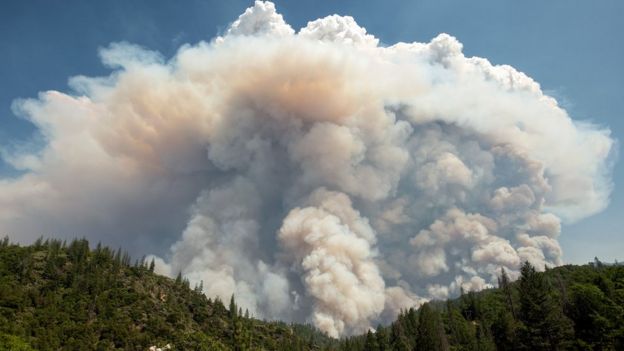
Here are my articles on how climate change is affect the world.  It is true that the world is heating up glaciers are melting, water levels are rising, lands are heating up, destroying crops, creating horrific fires that burn so hot, that they are creating their own weather patterns.  Action is required to help save our home, and it begins with education.  


Italy in the News

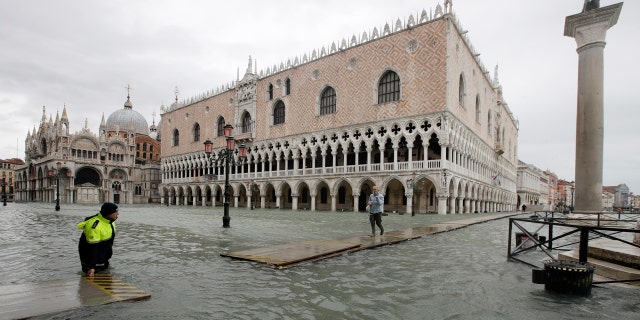
Venice flooding closes St. Mark's Square as city faces another 'tough day' of exceptional high tides

Fox News
A woman arrives in St. Mark's Square on a gangway, in spite of a ban, in Venice, Italy, Sunday, Nov. 17, 2019.


Australia in the news

Australia has been experiencing extreme drought due to global warming causing dangerous condition that has lead to horrific wildfires.  


Australia bushfires: How extreme 'firestorms' make their own weather


Zimbabwe, Africa in the news
CNN Article 

  • This is an article that I found on CNN that broke my heart.  I wanted to add this to my lesson, but forgot in the planning.  It would have gone perfectly with my groups plan; it would have connected more to them.  


California in the news
California Wildfires Result of 7 year Drought

Also, the California's wildfires are a desperate cry to global warming and the heating and drying of the earth.  What a place not to live right now.  the constant threat of fires that seems to hover over that state is incredible.  As it dredges through seven years of drought, the destruction and fear of fires has been present.
The 2018 wildfire season was the deadliest and most destructive wildfire season ever recorded in California, with a total of 8,527 fires burning an area of 1,893,913 acres.  This year, because of preperation and quicker alerts, the season has not been so bad, but the season is still on, and fires are still raging.  

click here for article


These are videos that I wanted to have access to for my lessons. Climate change has long been left out of elementary school curriculum.  The new Next Generation standards have started to introduce the concept, so now it's up to teachers to incorporate it into their lesson plans.  I will admit, I was not sure if students were ready for the harsh reality of Climate Change and all the catastrophes that are occurring, but after teaching the concept in my whole lesson plan, I am a strong believer that it needs to be included.  Even in small ways.     


Wednesday, October 16, 2019

Above & Beyond Technology in Learning


Useful diagrams


Fake News or Not? Internet Credibility

5Es of Internet Credibility
by Kathy Schrock
Who? Who wrote the pages and are they an expert? How can you find out more about them?


What?  What does the author say is the purpose of the site?  What makes the site easy to use?  What info is included? And what makes it different from other sites? 

When?  When was it created? When was it last updated?

Where?  Where does the info come from? Where can one find out more about the sponsor of the site?  


Why? Why is info useful for my purpose? why is this page better than another?


Fake News or Not??
Share your experience on your blogs.  


  • content is not projected in a scientific process that makes me believe its credibility.  The created/updated date is the future, The information presented is not hosted by a reputable scientific agency. 
  • As crazy as this is, it believe it is a legit site.  There are interactive simulations and windows that lead to further information about dog island.  There is ample information about the creators of the site.  there is no soliciting of information. 

  • Looks legit, and is great scientific knowledge.  Interactive and educational. 
  • As real as this site looks and interacts, I find the content to be made up.  It is not hosted by a science organization, nor do I relate to the topic of a tree octopus. 
    • Interactive and educationally sound for children.  Site has multiple windows on various topics and interrelate.  

    Teaching inquiry with Webquests

    WebQuests...

    A WebQuest is an inquiry-oriented lesson format in which most or all the information that learners work with comes from the web

    parts (elements) of WQ - 

    • Engagement/Introductdion
    • Explore/Investigate/Task
    • Explain/reflect/process
    • Elaborate/conclusion
    • Evaluate/assess


    WebQuests on Weather:
    Fourth Grade Severe Weather

    • This WebQuest will be helpful for my inquiry 
    • Lacks an evaluation element

    Climate Change

    Weather Vs. Climate

    Weather, Climate, Global Warming, Greenhouse Effects

    WebQuest on Weather and Climate Change

    Engagement:
    You are scientists researching the climate of a region and how climate change may be affecting it.  More specifically, you will be meteorologist and first research the local weather patterns during each season and determine the various climate.  Then you will look into climate change and how it may or may not be affecting the region.

    Explore:
    Using the internet, your team of scientists will create a powerpoint or slideshow of the different types of weather that make up your region's climate.  Include any extreme weather that is know to exist in the region.  Then discuss if the climate is changing and how it is affecting the region.  You will print out worksheets to guide you.  Your teams three minute powerpoint/slide show will describe the region you have been assigned, weather patterns, severe weather situations, climate, if climate change is prevalent, how it is affecting the region, and how the region is adapting or not.

    Explain: Let's get started..

    • Your region has been provided for you.  Make a slide that includes the name of the region and where geographically it is located in the world. http://www.worldatlas.com/
    • Print out the guiding sheets to help collect weather and climate data.  These will help to stay organized and guide you in completing each slide. 

    • Look up data using  http://www.nasa.gov/mission_pages/noaa-n/climate/climate_weather.htmlto determine weather and climate.  If you use outside resources, please reference them. 
    • watch this video on weather and climate and make notes on your guided sheets to about the difference between them. http://www.brainpop.com/science/weather/climatetypes/
    • For your region, find and state the following data for your region and include in a slide
      • Date, temperature, humidity, wind speed & direction, visibility, and dew point using this link http://www.weather.com/
    • research for severe weather patterns and how your region was affected.  Make a slide.
    • Make a paragraph about how your region was affected and what they did or could have done to protect themselves from the natural disasters.  
    • Does climate change affect the region?  How? Make a slide on the issue
    Elaborate:
    • Make a paragraph about how your region was affected and what they did or could have done to protect themselves from the natural disasters.  
    • Does climate change affect the region?  How? Make a slide on the issue
    • Share your presentation with your classmates
    Evaluate:
    Students will complete guided worksheets and turn them in.  Slideshow will be graded off rubric (facts, creativity, higher order of thinking)


    Friday, October 11, 2019

    Read It Chapter 8 & 9

    Using Technology to Enhance Science Learning
    Chapter 8

    "Technology for its own sake has just as much potential to destroy the message as it does to enhance it."


    My thoughts:  I agree with kindergarteners learning how to peruse through computers at school, exploring, and navigating through programs designed for their level.  Technology is unavoidable, and very prevalent to their education.  Not every child will have access to their own computer, and if they do, the exposer may not be educational, so I highly agree that schools should teach children age appropriate skills.  

    Recent reports are coming out about young children and screen time.  I wonder where we draw the line on what is reasonable and ok screen time.  Is reading books online hindering brain development in young children?  Is it part of the problem of screen time addiction?  
    I found an article that I would like to share 
    click here for article

    When using technology, it's important not to let it get ahead of the lesson.  It should be used to enhance learning and stimulate thinking, not for entertainment value.  That's where I struggle.  I tend to put videos of songs into my lesson plans so to meet the technology need, but I have often wondered its engagement factor.  

    Using Technology to Enhance evidence-based learning:
    • Science Webquest
    • Asking a scientist-I like this idea.  Websites that allow a real scientist to answer student questions.
    • Computer probe interfaces
    • Digital Microscopes
    • Virtual imaging
    • Authentic science experiences
    • Simulations-allow students to manipulate variables and see how the interactions among variables change the system.  Explorelearning.com
    There is a time for technology in learning, but there is a time for students to rely on their own creativity, peer sharing & collaborating that can enhance learning as well.  Using technology can be a crutch.  It's important to know the difference in engaging them and enabling them.  

    Chapter 9 
    Adapting the Science Curriculum
    • Todays classrooms are a multicultural community of children of different learning levels and languages. Providing reading material and science materials for non-english speakers is important.  Students who's english language skill are not as fluent should not be considered low learners.  Providing them material that they can understand and read, will allow them to learn and process content.  Science is tough enough, let alone trying to learn with minimal understanding.  
    • Integrating children with special needs in science education through differential learning strategies.  
    • Addressing needs of children with special gifts and talents through enrichments activities, challenge projects and other opportunities to use their unique talents and abilities.  Providing enriching experiences to advance understanding of science practices can also benefit all students. 


    Saturday, October 5, 2019

    Living Science Chapter 13-15

    Life Science
    Here is the link to the slide


    chapter 13
    Living Sciences: resources for teaching Living Science:

    I learn best by visual tactics.  Science is hard enough of a subject to learn as it is based on many facts and concepts. While teaching students science, I know I will use technology, posters, visuals and other tools to help students understand the principles of life science.  Asking studens to read and be expected to understand is a daunting task.  Science should be an inquiry based learning experience.   

      8 Characteristics of Life


    system- group of organs that work together to perform a major function

    • In humans, systems include skeletal system, muscular system, respiratory, nervous system, excretory and reproductive systems.  
    Classifying Living Things


    Animal Kingdom
    Animal Kingdom includes the invertebrates (animals with backbones, including hydra, jellyfishes, corals worms, mollusks, and jointed-leg animals) and vertebrates (animals with backbones, including fish, frogs, birds, and mammals). 


    Chapter 14

    The Human Body

    The Digestive System:

    • the process through which the body breaks down the molecules that make up the food that has been eaten and prepares them to react with oxygen to produce energy. 
    Skeletal-Muscular system:

    Respiratory System:

    Again, the importance of using multi-sensory tools to help teach science.  Visual aids are an important tool in learning science.  

    Chapter 15
    Lesson Ideas
    Ideas for Unit topics should align with Next Generation standards and school curriculum, text books, workshops, and student discussions.  Begin with a Unit Title, then create a question for students to explore.  this question serves as the anchor for the unit.  Inquiry lesson of the unit should contribute to a deeper, more comprehensive answer to the unit question.  An Inquiry-based lesson helps to engage students in exploring the topic and makes connection with prior knowledge and new information.  It also provides them freedom and responsibility of their own learning.   

    Starter Ideas/Webquest/Discovery Centers/Wonder Walls/Attention getters

    Image result for dancing skeleton gifThis chapter is a great resource for future lesson planning!!!!


    Tuesday, October 1, 2019

    Reading to Learn it: Chapters 1-3

    Notes for Reading

    Chapter 1
    Science seeks explanation to everyday questions.

    Science=strategies

    • teaching what to do when you don't know the answer, 
    • science thinking skill=tools to discovery
    Science is a way of knowing, explanations of the natural world, uses evidence to support it's clains.  
    • systematic quest
    • dynamic body of knowledge generated through a systematic quest for explanations
    Body of knowledge:  
    • energy can change form
    • Matter can change form
    • magnetic poles repel each other
    Inquiry Processing

    Descriptive                              Explanatory                           Experimental 
    Questioning.                            hypothesizing.                        predicting
    Classifying                              inferring                                  identifying
    Comparing                              interpretive                             communicating
                                                                                                    controlling variables

    Scientific Method
    Science as a set of value
    1. truth
    2. freedom
    3. skepticism
    4. order
    5. originality
    6. communication
    Scientific method is taught appropriately to the grade level, and will always reverse back around; reassessing. 


    Chapter 2. How Children Learn Science
    • Science is a way of knowing based on evidence-seeking explanations based on evidence
    • children come to you with prior knowledge about science
    • science is a progression
    • children learn science by doing science
    • there is variation in the rate of cognitive development among children.
    • Constructivism is a theory of human learning that is rooted in cognitive psychology and to a lesser extent, behavioral psychology. 
    1. naive conception
    2. assimilation and accommodating
    3. contributions of neuroscience
    Chapter 3.  
    Discovery seeks explanations based on observations, evidence and reflection

    Discovery learning=connect to past and future; interactive learning
    Inquiry=careful and systematic method of asking questions and seeking answers/explanations

    Learning through inquiry means students construct knowledge through the processes of asking questions, seeking evidence, formulation explanations based on evidence and justifying their explanations. 

    Learning to inquire-students become aware of and consciously apply the processess assoc with inquiry as part of their thinking strategies. 
    Inquiry questions- 
    • information-seeking
    • wonderment question-proposed relationship between 2 variables
    • how does it work
    • how to solve a problem question
    Use Models to represent their understanding
    Investigate
    analyze and interpret data-display data
    mathematical and computation thinking
    construct explanations
    obtaining evaluation and communication info


    Inquiry skills
    1. descriptive models-
      • observing                    
      • using space/time relation
      • using measurement
      • questioning
      • classifying, impose order
    2. Explanatory model-
      • inferring-using logic to make assumptions from what we observe and question
      • hypothesizing-a proposed relationship put forth to explain a phenomenon.  (predictions=the basis for an experiment)
    3. Experimental Model
      • experiments test predictions
      • Predictions- spec. forcast of a future observation or event.  Based on observation measurement and inferences about relationship betw. variable

    • Identifying Variables=factors that can make a difference in an investigation
    • independent variable-variable being tested
    • dependent variable-change that is measured 
    • controlled variable -effect of one variable all other factors must stay the same, only ind & dependent variable change.
    ex. 1. color of flower-independent
    butterflies-dependent
    time, lighting, same butterflies-controlled.  

    2. Bread in plastic bag in Room temp & in fridge...
    how long till it molds?  temp(Independent changes), time (dependent), Bread & bag are same (controlled).

    4. Interpreting Data-
    • finding patterns and trends based on the data collected in an investigation. 


    Commenting Reports

    Commenting Reports Responding to my colleagues blogs is an important tool for blogging. A blog is an outlet for us to relay information ...